- You are here:
- Home »
- Uncategorized »
- Market Review 2020: Looking Back on an Unprecedented Year
Market Review 2020: Looking Back on an Unprecedented Year
The year 2020 proved to be one of the most tumultuous in modern history, marked by a number of developments that were historically unprecedented. But the year also demonstrated the resilience of people, institutions, and financial markets.
The novel coronavirus was already in the news early in the year, and concerns grew as more countries began reporting their first cases of COVID-19. Infections multiplied around the world through February, and by early March, when the outbreak was labeled a pandemic, it was clear that the crisis would affect nearly every area of our lives. The spring would see a spike in cases and a global economic contraction as people stayed closer to home, and another surge of infections would come during the summer. Governments and central banks worked to cushion the blow, providing financial support for individuals and businesses and adjusting lending rates.
On top of the health crisis, there was widespread civil unrest over the summer in the US tied to policing and racial justice. In August, Americans increasingly focused on the US presidential race in this unusual year. Politicians, supporters, and voting officials wrestled with the challenges of a campaign that at times was conducted virtually and with an election in the fall that would include a heightened level of mail-in and early voting. In the end, the results of the election would be disputed well into December. As autumn turned to winter, 2020 would end with both troubling and hopeful news: yet another spike in COVID-19 cases, along with the first deliveries of vaccines in the US and elsewhere.
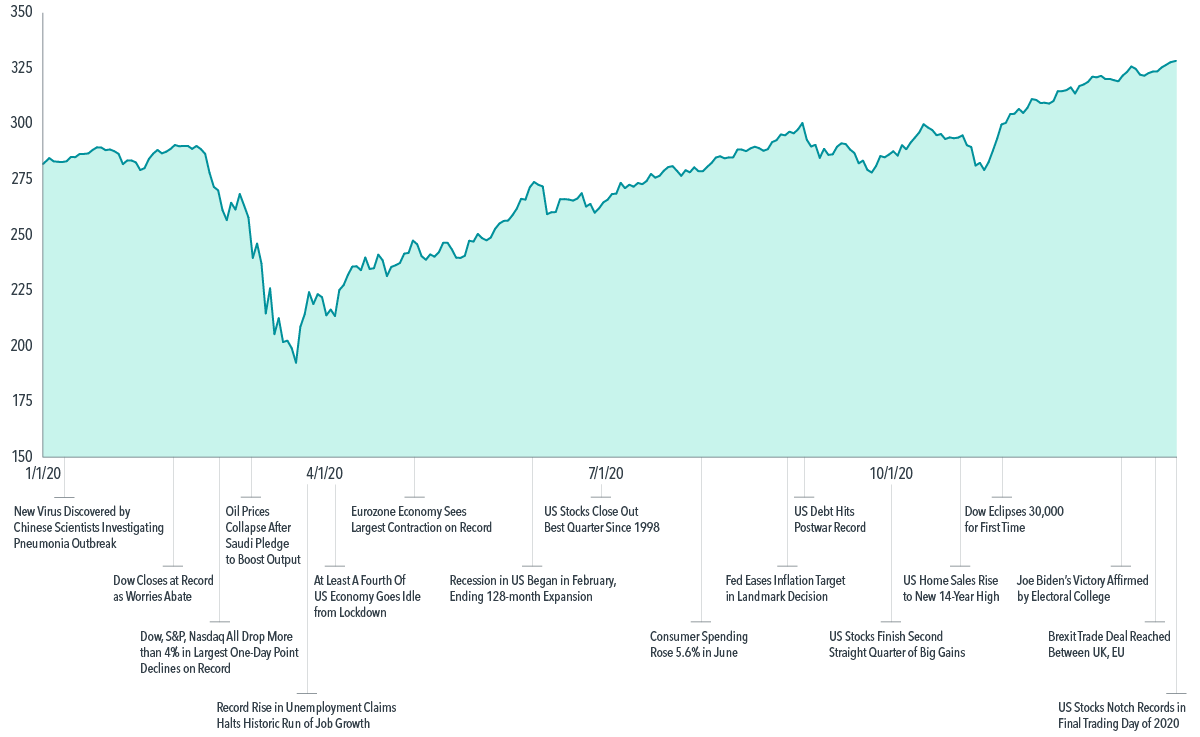
For investors, the year was characterized by sharp swings for stocks. March saw a 33.79% drop in the S&P 500 Index1 as the pandemic worsened. This was followed by a rally in April, and stocks reached their previous highs by August. Ultimately, despite a sequence of epic events and continued concerns over the pandemic, global stock market returns in 2020 were above their historical norm. The US market finished the year in record territory and with an 18.40% annual return for the S&P 500 Index. Non-US developed markets, as measured by the MSCI World ex USA Index,2 returned 7.59%. Emerging markets, as measured by the MSCI Emerging Markets Index, returned 18.31% for the year.EXHIBIT 1
Highs and Lows
MSCI All Country World Index with selected headlines from 2020
Past performance is no guarantee of future results.
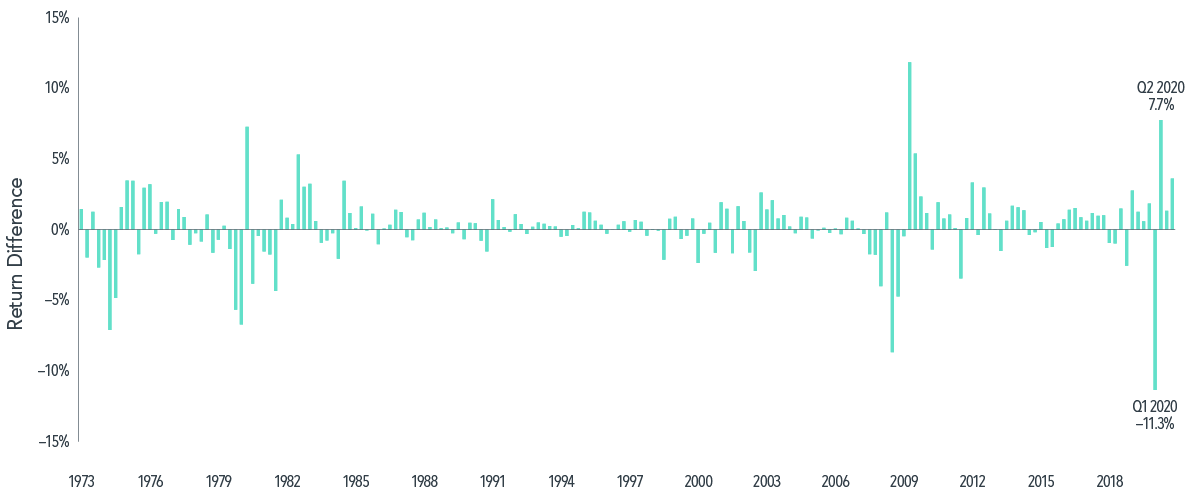
Fixed income markets mirrored the extremity of equity behavior, with nearly unprecedented dispersion in returns during the first half of 2020. For example, in the first quarter, US corporate bonds underperformed US Treasuries by more than 11%, the most negative quarterly return difference in data going back a half century. But they soon swapped places: the second quarter was the second-most positive one on record for corporates over Treasuries, with a 7.74% advantage.3 Large return deviations were also observed between US and non-US fixed income as well as between inflation-protected and nominal bonds.
Global yield curves finished the year generally lower than at the start. US Treasury yields, for example, fell across the board, with drops of more than 1% on the short and intermediate portions of the curve.4 The US Treasury curve ended relatively flat in the short-term segment but upwardly sloped from the intermediate- to long-term segment. For 2020, the Bloomberg Barclays Global Aggregate Bond Index5 returned 5.58%.EXHIBIT 2
Sharp Shifts
US Credit minus US Treasury: Quarterly Returns, March 1973–December 2020
Past performance is no guarantee of future results.
Uncertainty remains about the pandemic and the broad impact of the new vaccines, continued lockdowns, and social distancing. But the events of 2020 provided investors with many lessons, affirming that following a disciplined and broadly diversified investment approach is a reliable way to pursue long-term investment goals.
Market Prices Quickly Reflect New Information about the Future
The fluctuating markets in the spring and summer were also a lesson in how markets incorporate new information and changes in expectations. From its peak on February 19, 2020, the S&P 500 Index fell 33.79% in less than five weeks as the news headlines suggested more extreme outcomes from the pandemic. But the recovery would be swift as well. Market participants were watching for news that would provide insights into the pandemic and the economy, such as daily infection and mortality rates, effective therapeutic treatments, and the potential for vaccine development. As more information became available, the S&P 500 Index jumped 17.57% from its March 23 low in just three trading sessions, one of the fastest snapbacks on record. This period highlighted the vital role of data in setting market expectations and underscored how quickly prices adjust to new information.
One major theme of the year was the perceived disconnect between markets and the economy. How could the equity markets recover and reach new highs when the economic news remained so bleak? The market’s behavior suggests investors were looking past the short-term impact of the pandemic to assess the expected rebound of business activity and an eventual return to more-normal conditions. Seen through that lens, the rebound in share prices reflected a market that is always looking ahead, incorporating both current news and expectations of the future into stock prices.
Owning the Winners and Losers
The 2020 economy and market also underscored the importance of staying broadly diversified across companies and industries. The downturn in stocks impacted some segments of the market more than others in ways that were consistent with the impact of the COVID-19 pandemic on certain types of businesses or industries. For example, airline, hospitality, and retail industries tended to suffer disproportionately with people around the world staying at home, whereas companies in communications, online shopping, and technology emerged as relative winners during the crisis. However, predicting at the beginning of 2020 exactly how this might play out would likely have proved challenging.
In the end, the economic turmoil inflicted great hardship on some firms while creating economic and social conditions that provided growth opportunities for other companies. In any market, there will be winners and losers—and investors have historically been well served by owning a broad range of companies rather than trying to pick winners and losers.
Sticking with Your Plan
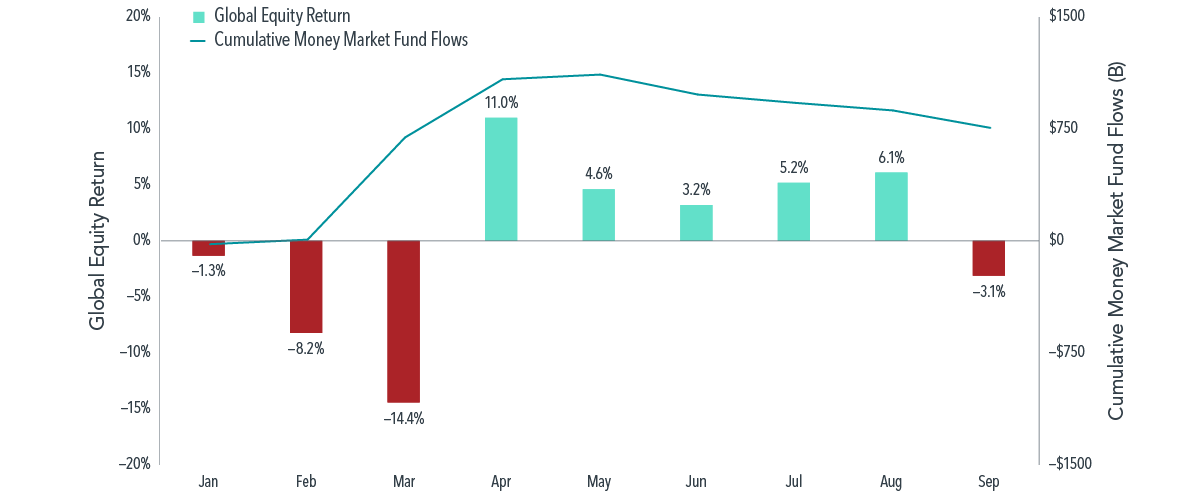
Many news reports rightly emphasized the unprecedented nature of the health crisis, the emergency financial actions, and other extraordinary events during 2020. The year saw many “firsts”—and subsequent years will doubtless usher in many more. Yet 2020’s outcomes remind us that a consistent investment approach is a reliable path regardless of the market events we encounter. Investors who made moves by reacting to the moment may have missed opportunities. In March, spooked investors fled the stock and bond markets, as money-market funds experienced net flows for the month totaling $684 billion. Then, over the six-month period from April 1 to September 30, global equities and fixed income returned 29.54% and 3.16%, respectively. A move to cash in March may have been a costly decision for anxious investors.
EXHIBIT 3
Cash Concerns in 2020
Past performance is no guarantee of future results.
It was important for investors to avoid reacting to the dispersion in performance between asset classes, too, lest they miss out on turnarounds from early in the year to later. For example, small cap stocks on the whole fared better in the second half of the year than the first. The stark difference in performance between the first and second quarters across bond classes also drives home this point.
A Welcome Turn of the Calendar
Moving into 2021, many questions remain about the pandemic, new vaccines, business activity, changes in how people work and socialize, and the direction of global markets. Yet 2020’s economic and market tumult demonstrated that markets continue to function and that people can adapt to difficult circumstances. The year’s positive equity and fixed income returns remind that, with a solid investment approach and a commitment to staying the course, investors can focus on building long-term wealth, even in challenging times.
FOOTNOTES
- 1S&P data © 2021 S&P Dow Jones Indices LLC, a division of S&P Global. All rights reserved. Indices are not available for direct investment.
- 2MSCI data © MSCI 2021, all rights reserved. Indices are not available for direct investment.
- 3US corporate bonds represented by the Bloomberg Barclays US Credit Bond Index. US Treasuries represented by the Bloomberg Barclays US Treasury Bond Index. Bloomberg Barclays data provided by Bloomberg. Indices are not available for direct investment.
- 4ICE BofA government yield. ICE BofA index data © 2021 ICE Data Indices, LLC.
- 5Bloomberg Barclays data provided by Bloomberg. All rights reserved. Indices are not available for direct investment.
DISCLOSURES
The information in this document is provided in good faith without any warranty and is intended for the recipient’s background information only. It does not constitute investment advice, recommendation, or an offer of any services or products for sale and is not intended to provide a sufficient basis on which to make an investment decision. It is the responsibility of any persons wishing to make a purchase to inform themselves of and observe all applicable laws and regulations. Unauthorized copying, reproducing, duplicating, or transmitting of this document are strictly prohibited. Dimensional accepts no responsibility for loss arising from the use of the information contained herein.
“Dimensional” refers to the Dimensional separate but affiliated entities generally, rather than to one particular entity. These entities are Dimensional Fund Advisors LP, Dimensional Fund Advisors Ltd., Dimensional Ireland Limited, DFA Australia Limited, Dimensional Fund Advisors Canada ULC, Dimensional Fund Advisors Pte. Ltd, Dimensional Japan Ltd., and Dimensional Hong Kong Limited. Dimensional Hong Kong Limited is licensed by the Securities and Futures Commission to conduct Type 1 (dealing in securities) regulated activities only and does not provide asset management services.
UNITED STATES: Dimensional Fund Advisors LP is an investment advisor registered with the Securities and Exchange Commission.
About the Author Mitch
Mitchell Bloom is President and founder of Bloom Financial, LLC. Bloom is a boutique financial planning firm. It specializes in transactional tax planning. It also focuses on retirement income planning, estate planning, and investment management. The company prides itself on its cornerstone, “Financial Advice in Plain English.” With over 36 years of helping 100’s of clients with retirement planning, Mitch has taught classes for some of the largest institutions in Colorado. Over the last three years, modernization of financial services technology has streamlined and simplified client financial planning facilitation. It has also expanded outreach capacity, planning options, and reporting capabilities. This new partnership best helps individuals and families with highly appreciated businesses, stock, crypto, art, CRE, and rental properties. It also serves highly compensated executives and business owners. The Bloom Financial/FourStar partnership increases clients’ reach in the ever-evolving world of financial planning breakthroughs, tactics, and tools. The firm consults industry economists in addition to different viewpoints of The Capital Market Assumptions 10-year Outlook. For example, the decade starting in 2024, assumptions for U.S. equities range from Vanguard’s 4.2%-6.2% to BNY Mellon’s 7.4%1, 2. These numbers are well below the market average. President, Mitchell Bloom said, “the standard 60/40 model portfolio may be facing a tough decade ahead. One of our goals is to improve clients’ chances of investment success using diversified alternative investments. We get excited teaching clients about our Core-Satellite investment philosophy commonly used by institutional investors and universities like Yale and Harvard. For clients who qualify, we tilt their Satellite portfolios towards alt funds. These invest in start-ups, angel investments, private equity, hedge funds, and real estate.” Bloom’s mission is to help clients become liberated from the stress and anxiety of understanding taxes, markets, retirement, and the transfer of wealth to the next generation. Over the last 36 years, Bloom has developed a nationwide team of trustees, tax attorneys, CPAs, business brokers, certified financial planners. They also work with insurance auditors, art appraisers, custodian banks, third party service providers, and investment advisory firms. FourStar Wealth Advisors is a Registered Investment Advisor firm headquartered in Chicago. FourStar Wealth is an independent firm without the conflicts or restrictions of the old school firms. We believe success in achieving financial goals starts with a comprehensive wealth strategy. We help you define what is most important to you and formulate the strategies suited for your needs This applies to whether you are accumulating wealth or investing for income, solidifying your retirement plan, or devising a distribution approach that meets your lifestyle and legacy goals. Bloom is a Registered Investment Advisor Representative with FourStar Wealth Advisors of Chicago and is partnered with Buckingham Strategic Partners for portfolio management, financial planning, and back-office support. Founded in strategic investing that is scientific, consistent, and above all, based on decades of research and innovation. Buckingham Strategic Partners Investment Committee has included noted academics Dr. Harry Markowitz, winner of the Nobel Prize in Economics in 1990, and Dr. Meir Statman, one of the pioneers in the field of behavioral finance. Passion and integrity are at the heart of the firm’s values, actions, and culture.
follow me on: