Archive

Category Archives for "Uncategorized"

Another day, another debt ceiling.


In the 245 years since the signing of the Declaration of Independence, the United States has never once defaulted on its debt.  But all that could change on October 18 if Congress does not raise the debt ceiling.  Should that happen, there’s a very real possibility that the U.S. would be unable to pay its bills – or at least, have to prioritize which bills it pays and which it does not.  

Now, I know what you’re thinking.  “The debt ceiling?  This again?”  And yes, it’s true.  Just like in 2011, and again in 2013, our legislature is once again confronted with a debt ceiling crisis of its own making.  Unfortunately, the debt ceiling is not some arcane Congressional procedure.  If the US were to default on its debt – more on that in a minute – then it would likely have a very real impact on the stock market, the economy, and even people’s individual finances.
 
This is a story that will likely dominate the news more and more in the coming weeks.  And as we get closer to that October 18 deadline I mentioned, it may prompt more uncertainty in the markets, which have already been volatile of late.  But as I always like to say, nothing in life is to be feared, just understood…and planned for.  So, to help you prepare for the spate of headlines coming our way, let’s do a Q&A on the debt ceiling.  Here are some of the most common questions I’ve been getting from clients on the subject.
 
1.  What is the debt ceiling?  

Many people think that the debt ceiling is a cap on how much total money our government can spend, but it’s not.  This is actually an important point.  In truth, the debt ceiling is “the total amount of money that the United States government is authorized to borrow to meet its existing legal obligations.”1
Now, what are these existing legal obligations?  It’s a massive list, including everything from Social Security and Medicare benefits to tax refunds, interest payments on our national debt, military salaries, and debt to anyone who owns U.S. government bonds.
The debt ceiling, then, is the legal limit to what the government can borrow to pay for money it has already spent (or committed to spending).  In this case, Congress needs to raise the debt ceiling to pay the bills it has incurred over the past several years.
 
2.  Why doesn’t the debt ceiling limit government spending?  

To understand this, we must understand the difference between government spending and government borrowing.  The two are not interchangeable.
First, let’s look at what government spending actually is.  When Congress passes a law, the government must spend money to enact it.  There are two types of legislation used to get that money.  Sometimes Congress authorizes a law, but the authorization doesn’t contain provisions to fund the law.  A separate piece of legislation, known as an appropriations bill, is required.  This is where Congress separately appropriates money for the new law.  These appropriations must be renewed, usually on an annual basis, for the law to remain funded.  This sort of thing is known as discretionary spending, because Congress decides upon its own discretion whether to continue funding the law.
 
Other laws fall under the umbrella of mandatory spending.  When a new law is enacted that does contain the authority for funding, then Congress is required to fund the law perpetually until the law expires (assuming the law has an expiration date).  Social Security and Medicare, for example, fall under mandatory spending.
Now, here’s the important part.  Sometimes Congress doesn’t have the money to pay for the laws it previously enacted, especially the larger mandatory programs.  But Congress can’t simply not pay for them.  A law is a law, and Congress is legally obligated to find the money to fund them.  So, in those cases, Congress must borrow the money it is compelled to spend.  That’s the difference between borrowing and spending, and the debt ceiling only applies to the former.  It limits how much the government can borrow to cover what it has already spent.  

3.  This seems so complicated and unnecessary!  Why do we even have a debt ceiling anyway?

The United States is actually one of the few countries to have a debt ceiling.  Ours originated in 1917, during World War I.2  To put it simply, Congress was tired of having to approve borrowing every time the government needed money.  Think of it like having a massive family meeting every time someone in your extended family wants to borrow a few bucks.  So, Congress decided to grant approval to any borrowing so long as it didn’t exceed a specified amount.  Thus, the debt ceiling was born.
 
For most of the past hundred years, raising the debt ceiling was a fairly uncontroversial process.  In fact, the ceiling has been raised or suspended nearly 80 times since 1960 alone.3  But over the decades, as Congress has become more partisan, and politics has become more of a blood sport, the debt ceiling has transformed into a political football.  At various times, both Republicans and Democrats have tried to delay raising the debt ceiling or block it altogether.  They do this to either wring political concessions or paint the other party as being fiscally irresponsible.
 
I know.  It’s frustrating.
 
4.  Okay, so what’s happening on October 18?  

This is the date that Janet Yellen, the Secretary of the Treasury, has indicated the government will run out of money.  After that point, per her recent testimony to Congress, “…we expect Treasury would be left with very limited resources that would be depleted quickly.  It is uncertain whether we could continue to meet all the nation’s commitments after that date.”4 

This essentially gives Congress four options:

Drastically raise taxes to make up the difference in spending and revenue, so that the Treasury no longer needs to borrow money.  This is politically impossible and will not happen.    

Drastically cut spending to make up the difference.  (Not going to happen either, for the same reasons as above.  Furthermore, neither of these two actions could be done before the October 18 deadline.)

Raise the debt ceiling.

Default on what it owes.

As of this writing, the Democrats, being in power, want to raise the debt ceiling.  The Republicans do not and are essentially daring Democrats to do it on their own.  To do this, though, Democrats would have to use an extremely complicated procedure called budget reconciliation.  Normally, it requires 60 votes to raise the debt ceiling, meaning some Republicans would have to sign on.  Using reconciliation, Democrats could do it with their simple 50 vote majority.  But this would be an untested and extremely time-consuming process.  It also wouldn’t look good politically.

To be clear, most experts expect the debt ceiling to be raised some way, somehow, before the October 18 deadline.  Either Republicans will cave, or Democrats will, but it will get done.  That’s what happened in 2013 and 2011, despite all the 11th hour drama – because both parties know the ramification of not acting.  On the other hand, as we say in the financial industry, past performance is no guarantee of future results.  So, let’s look at what the ramifications would be if the US were to default on its debt.
 
5.  What happens if the debt ceiling isn’t raised and the government defaults?
  
To be clear, no one entirely knows for sure.  That’s because it’s never happened before.  However, we can make some educated guesses.  To be honest, they don’t look good.

Deep breath here…
 
For starters, seniors could stop receiving Social Security payments, or at least experience delays.  Families could stop receiving Child Tax Credit Payments, or at least experience delays.  Members of the US military would stop receiving paychecks, as would federal employees.  Veterans’ benefits would be delayed.  Food assistance for the hungry, homeless, poor, and malnourished could stop.  Funding for victims of the recent hurricanes and wildfires could stop.  Funding to combat the COVID-19 pandemic could dry up.5 

As if those aren’t bad enough, the effects of a default would also extend to the broader economy – and the markets.  The country’s credit rating would probably be downgraded, as it was in 2011.  Because bondholders wouldn’t be paid, the value of their bonds would drop, leading to simultaneously higher yields. This could lead to dramatically higher interest rates, which would make it harder for people to pay their mortgages and credit card payments.  All this would shock the stock market, too.
Earlier in September, Moody’s Analytics, one of the top economic researchers in the world, estimated that the country would fall into another recession if the debt ceiling weren’t lifted.6  Up to six million jobs could be lost.  Unemployment would skyrocket back to 9%.  $15 trillion in household wealth could be wiped out.  All while we are still recovering from the last recession.
 
There are no two ways about it.  It’s a grim picture.
 
Now, again: Most experts, and politicians for that matter, do not expect this to happen.  But it could.  Right now, Congress is playing a game of “chicken” – and that’s not what we elected our legislature to do.
 
That means that we, as private citizens and responsible investors, need to be what Congress is not: Prepared.
 
6.  So, what do we do about this?  

What you can do, is simple.  First, prepare yourself mentally and emotionally for a spate of scary-sounding headlines.  Second, remember that my team and I are keeping a close eye on things.
 
This is what we see: Uncertainty dominates.  No one knows exactly what will happen.  But I don’t believe in making decisions based off uncertainty.  I don’t believe in making decisions based on fear.   Again, we’ve heard this song and dance before.  Rather than assuming the worst, we’ll just keep paying attention.  We’ll monitor your investments and Washington as closely as possible.  That way, nothing will take us by surprise.  If we feel your investments should be “moved to higher ground”, we’ll let you know immediately.
 
Of course, if you have any questions or concerns, let me know!  I’d love to talk with you and put your mind at ease.  In the meantime, we’ll keep doing what we do best: Planning ahead, keeping the big picture in mind, and being proactive.


As always, if you have any questions, please do not hesitate to call by contacting Amy at 800-WAY-KOOL, (800-929-5665)
Market Review 2020: Looking Back on an Unprecedented Year

The year 2020 proved to be one of the most tumultuous in modern history, marked by a number of developments that were historically unprecedented. But the year also demonstrated the resilience of people, institutions, and financial markets.

The novel coronavirus was already in the news early in the year, and concerns grew as more countries began reporting their first cases of COVID-19. Infections multiplied around the world through February, and by early March, when the outbreak was labeled a pandemic, it was clear that the crisis would affect nearly every area of our lives. The spring would see a spike in cases and a global economic contraction as people stayed closer to home, and another surge of infections would come during the summer. Governments and central banks worked to cushion the blow, providing financial support for individuals and businesses and adjusting lending rates.

On top of the health crisis, there was widespread civil unrest over the summer in the US tied to policing and racial justice. In August, Americans increasingly focused on the US presidential race in this unusual year. Politicians, supporters, and voting officials wrestled with the challenges of a campaign that at times was conducted virtually and with an election in the fall that would include a heightened level of mail-in and early voting. In the end, the results of the election would be disputed well into December. As autumn turned to winter, 2020 would end with both troubling and hopeful news: yet another spike in COVID-19 cases, along with the first deliveries of vaccines in the US and elsewhere.

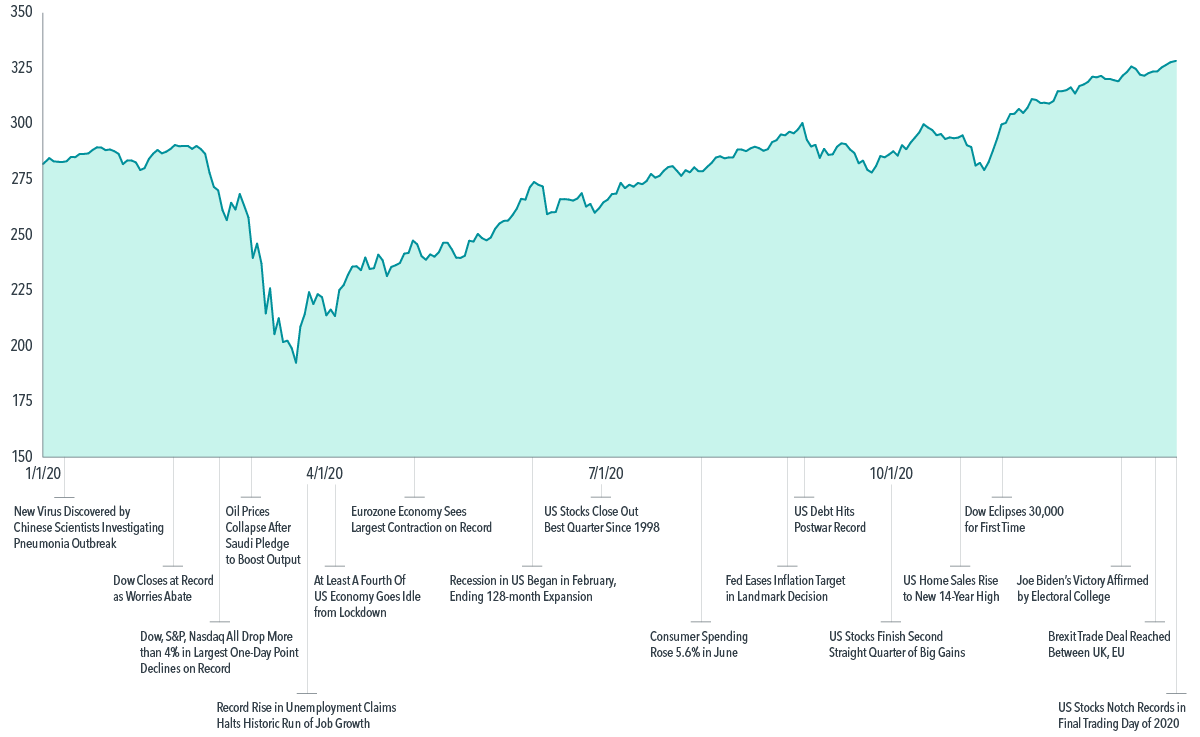
For investors, the year was characterized by sharp swings for stocks. March saw a 33.79% drop in the S&P 500 Indexas the pandemic worsened. This was followed by a rally in April, and stocks reached their previous highs by August. Ultimately, despite a sequence of epic events and continued concerns over the pandemic, global stock market returns in 2020 were above their historical norm. The US market finished the year in record territory and with an 18.40% annual return for the S&P 500 Index. Non-US developed markets, as measured by the MSCI World ex USA Index,2 returned 7.59%. Emerging markets, as measured by the MSCI Emerging Markets Index, returned 18.31% for the year.EXHIBIT 1

Highs and Lows

MSCI All Country World Index with selected headlines from 2020
Highs and Lows

Past performance is no guarantee of future results.

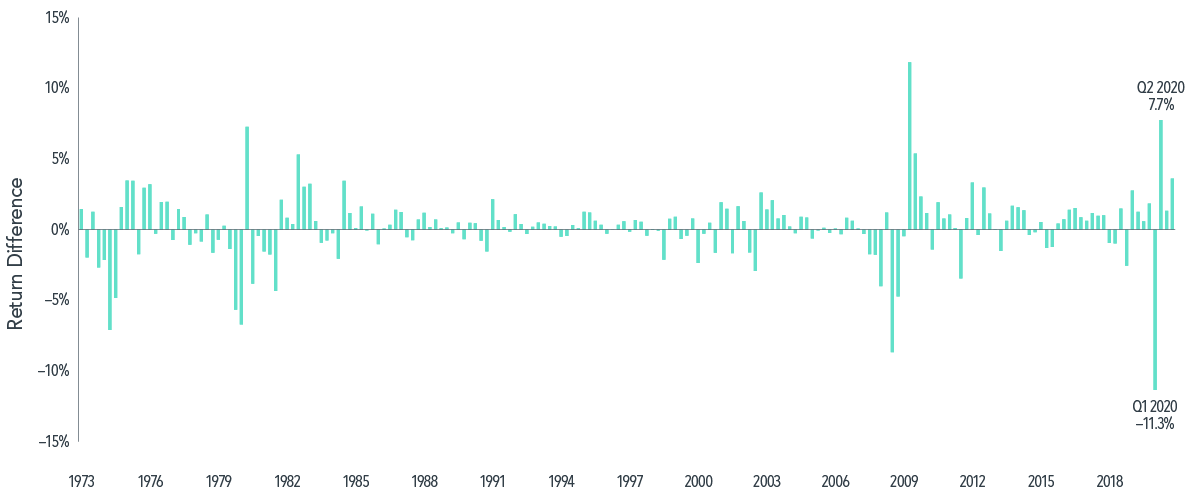
Fixed income markets mirrored the extremity of equity behavior, with nearly unprecedented dispersion in returns during the first half of 2020. For example, in the first quarter, US corporate bonds underperformed US Treasuries by more than 11%, the most negative quarterly return difference in data going back a half century. But they soon swapped places: the second quarter was the second-most positive one on record for corporates over Treasuries, with a 7.74% advantage.3 Large return deviations were also observed between US and non-US fixed income as well as between inflation-protected and nominal bonds.

Global yield curves finished the year generally lower than at the start. US Treasury yields, for example, fell across the board, with drops of more than 1% on the short and intermediate portions of the curve.4 The US Treasury curve ended relatively flat in the short-term segment but upwardly sloped from the intermediate- to long-term segment. For 2020, the Bloomberg Barclays Global Aggregate Bond Indexreturned 5.58%.EXHIBIT 2

Sharp Shifts

US Credit minus US Treasury: Quarterly Returns, March 1973–December 2020
Sharp Shifts

Past performance is no guarantee of future results.

Uncertainty remains about the pandemic and the broad impact of the new vaccines, continued lockdowns, and social distancing. But the events of 2020 provided investors with many lessons, affirming that following a disciplined and broadly diversified investment approach is a reliable way to pursue long-term investment goals.

Market Prices Quickly Reflect New Information about the Future 

The fluctuating markets in the spring and summer were also a lesson in how markets incorporate new information and changes in expectations. From its peak on February 19, 2020, the S&P 500 Index fell 33.79% in less than five weeks as the news headlines suggested more extreme outcomes from the pandemic. But the recovery would be swift as well. Market participants were watching for news that would provide insights into the pandemic and the economy, such as daily infection and mortality rates, effective therapeutic treatments, and the potential for vaccine development. As more information became available, the S&P 500 Index jumped 17.57% from its March 23 low in just three trading sessions, one of the fastest snapbacks on record. This period highlighted the vital role of data in setting market expectations and underscored how quickly prices adjust to new information.

One major theme of the year was the perceived disconnect between markets and the economy. How could the equity markets recover and reach new highs when the economic news remained so bleak? The market’s behavior suggests investors were looking past the short-term impact of the pandemic to assess the expected rebound of business activity and an eventual return to more-normal conditions. Seen through that lens, the rebound in share prices reflected a market that is always looking ahead, incorporating both current news and expectations of the future into stock prices.

Owning the Winners and Losers

The 2020 economy and market also underscored the importance of staying broadly diversified across companies and industries. The downturn in stocks impacted some segments of the market more than others in ways that were consistent with the impact of the COVID-19 pandemic on certain types of businesses or industries. For example, airline, hospitality, and retail industries tended to suffer disproportionately with people around the world staying at home, whereas companies in communications, online shopping, and technology emerged as relative winners during the crisis. However, predicting at the beginning of 2020 exactly how this might play out would likely have proved challenging.

In the end, the economic turmoil inflicted great hardship on some firms while creating economic and social conditions that provided growth opportunities for other companies. In any market, there will be winners and losers—and investors have historically been well served by owning a broad range of companies rather than trying to pick winners and losers.

Sticking with Your Plan

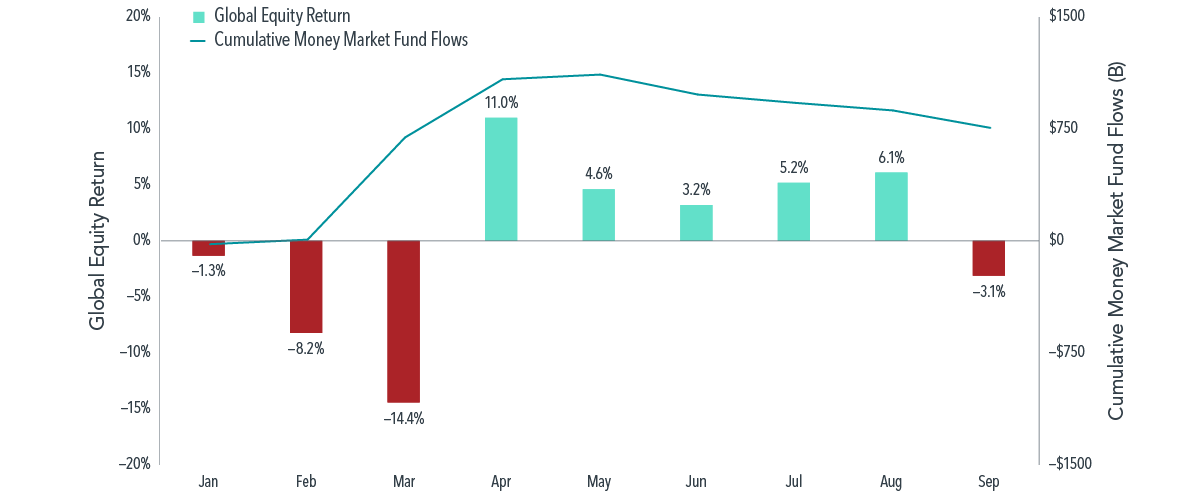
Many news reports rightly emphasized the unprecedented nature of the health crisis, the emergency financial actions, and other extraordinary events during 2020. The year saw many “firsts”—and subsequent years will doubtless usher in many more. Yet 2020’s outcomes remind us that a consistent investment approach is a reliable path regardless of the market events we encounter. Investors who made moves by reacting to the moment may have missed opportunities. In March, spooked investors fled the stock and bond markets, as money-market funds experienced net flows for the month totaling $684 billion. Then, over the six-month period from April 1 to September 30, global equities and fixed income returned 29.54% and 3.16%, respectively. A move to cash in March may have been a costly decision for anxious investors.
EXHIBIT 3

Cash Concerns in 2020

Cash Concerns in 2020

Past performance is no guarantee of future results.

It was important for investors to avoid reacting to the dispersion in performance between asset classes, too, lest they miss out on turnarounds from early in the year to later. For example, small cap stocks on the whole fared better in the second half of the year than the first. The stark difference in performance between the first and second quarters across bond classes also drives home this point.

A Welcome Turn of the Calendar

Moving into 2021, many questions remain about the pandemic, new vaccines, business activity, changes in how people work and socialize, and the direction of global markets. Yet 2020’s economic and market tumult demonstrated that markets continue to function and that people can adapt to difficult circumstances. The year’s positive equity and fixed income returns remind that, with a solid investment approach and a commitment to staying the course, investors can focus on building long-term wealth, even in challenging times.

FOOTNOTES

  1. 1S&P data © 2021 S&P Dow Jones Indices LLC, a division of S&P Global. All rights reserved. Indices are not available for direct investment.
  2. 2MSCI data © MSCI 2021, all rights reserved. Indices are not available for direct investment.
  3. 3US corporate bonds represented by the Bloomberg Barclays US Credit Bond Index. US Treasuries represented by the Bloomberg Barclays US Treasury Bond Index. Bloomberg Barclays data provided by Bloomberg. Indices are not available for direct investment.
  4. 4ICE BofA government yield. ICE BofA index data © 2021 ICE Data Indices, LLC.
  5. 5Bloomberg Barclays data provided by Bloomberg. All rights reserved. Indices are not available for direct investment.

DISCLOSURES

The information in this document is provided in good faith without any warranty and is intended for the recipient’s background information only. It does not constitute investment advice, recommendation, or an offer of any services or products for sale and is not intended to provide a sufficient basis on which to make an investment decision. It is the responsibility of any persons wishing to make a purchase to inform themselves of and observe all applicable laws and regulations. Unauthorized copying, reproducing, duplicating, or transmitting of this document are strictly prohibited. Dimensional accepts no responsibility for loss arising from the use of the information contained herein.

“Dimensional” refers to the Dimensional separate but affiliated entities generally, rather than to one particular entity. These entities are Dimensional Fund Advisors LP, Dimensional Fund Advisors Ltd., Dimensional Ireland Limited, DFA Australia Limited, Dimensional Fund Advisors Canada ULC, Dimensional Fund Advisors Pte. Ltd, Dimensional Japan Ltd., and Dimensional Hong Kong Limited. Dimensional Hong Kong Limited is licensed by the Securities and Futures Commission to conduct Type 1 (dealing in securities) regulated activities only and does not provide asset management services.

UNITED STATES: Dimensional Fund Advisors LP is an investment advisor registered with the Securities and Exchange Commission.

What You Need to Know About Stimulus 2.0

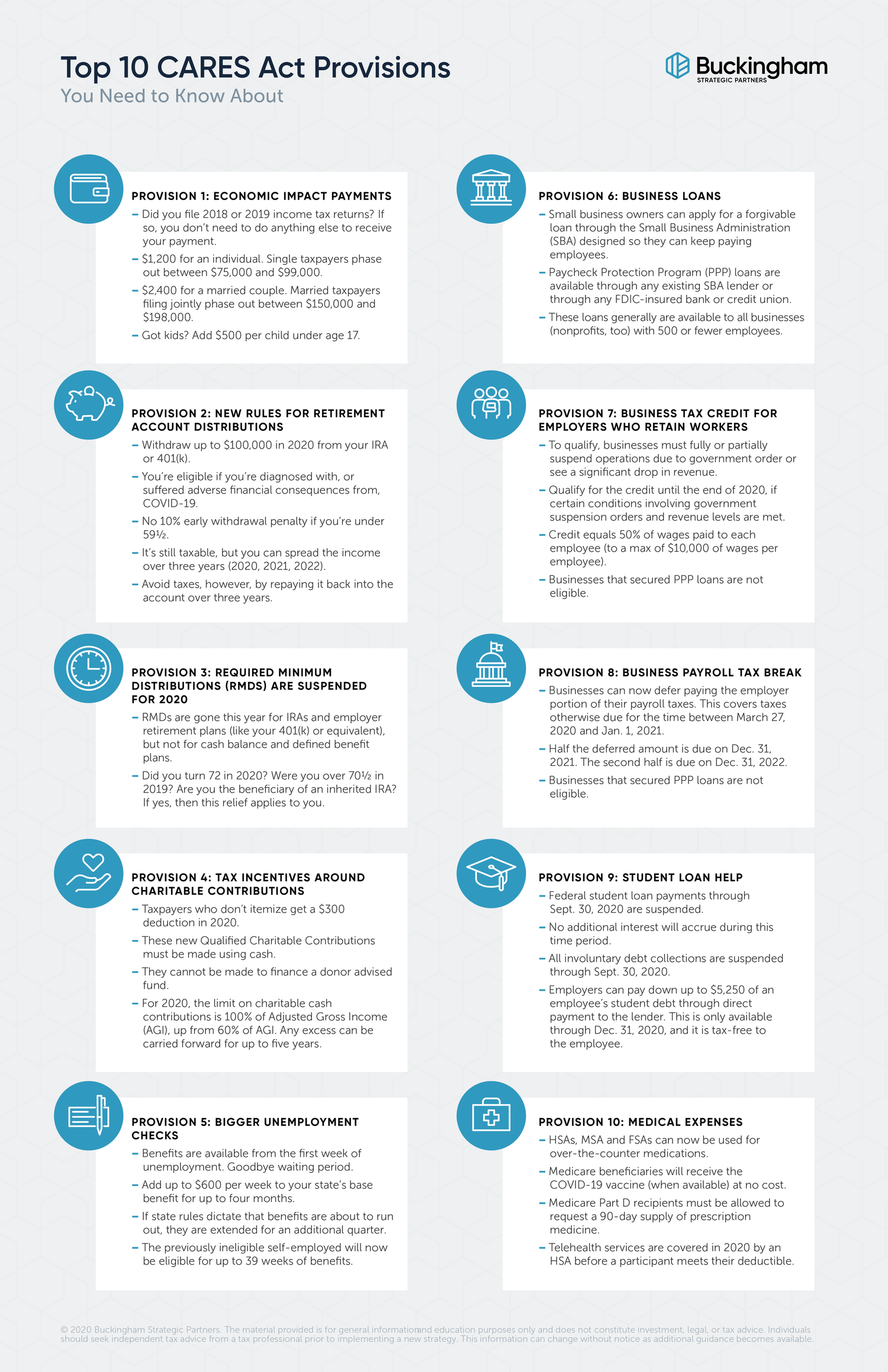
After nearly six months of back-and-forth negotiations, and in response to the economic hardship that many Americans face from the ongoing COVID-19 pandemic, Congress proposed a new, $900 billion relief package.

Many elements—like stimulus payments and PPP loans—will sound familiar from earlier this year.

However, debate surrounding certain provisions in the economic stimulus and relief package has intensified since it left Congress, and as of this posting, President Trump has yet to sign the bill.

Luckily, should it become law, few measures in the whopping 5,593-page bill require prompt action before the end of 2020. Nevertheless, extensive media coverage has prompted questions regarding how it will affect you and your family. To help offer some clarity, here’s a high-level breakdown of six important provisions in the bill you need to know about.

Stimulus checks

The latest round of stimulus checks largely mirrors the rules and guidelines that were used for the first round authorized by the CARES Act, with a few notable changes. The most significant change for most people is that the latest round authorizes a base credit of $600 per eligible individual. Eligible individuals include the taxpayer (or, in the case of a joint return, the taxpayers) filing the return as well as any children for whom a Child Tax Credit may be claimed (they must be younger than age 17). As was the case under the CARES Act, your base rebate under the latest stimulus bill begins to be phased out as your income exceeds an applicable threshold.

As was the case under the CARES Act for the initial Recovery Rebate, your base Additional Recovery Rebate under the latest stimulus bill begins to be phased out as your income exceeds an applicable threshold. More specifically, for every $100 of Adjusted Gross Income (AGI) you exceed your applicable threshold, $5 of Additional Recovery Rebate will be phased out.

Thus, the phaseout range varies from taxpayer to taxpayer, depending upon the size of your base Additional Recovery Rebate (i.e., the more eligible individuals, the larger the dollar amount to be phased out at $5 per $100 of AGI, and the more income it will take to fully phase out the rebate check).

The AGI thresholds (unchanged from the CARES Act) where a taxpayer’s base Additional Recovery Rebate begins to be phased out are:

  • Single Filer: $75,000
  • Joint Filer: $150,000
  • Head of Household Filer: $112,500

Finally, it’s worth noting that while the Additional Recovery Rebate is a 2020 refundable credit, it will be paid as soon as possible based on the AGI report on your 2019 tax return.

Return of the Paycheck Protection Program

One of the centerpieces of the latest COVID-19 relief package is the introduction of a potential second loan under the Paycheck Protection Program (PPP).

It reopens the original PPP, makes meaningful revisions to the rules (applicable to both the original and the new versions), and provides important clarifications. All of this additional relief may come as welcome news if you’re a small business owner whose revenue continues to suffer as a result of the COVID-19 pandemic.

For those businesses who have yet to receive a loan under the PPP, the ability to apply for round one financing will be reopened. The qualifications and the rules for that program remain largely the same.

By contrast, those businesses who have already received a loan under the original PPP but need additional capital may be able to receive a second loan under the new version. The program’s latest iteration, however, has more stringent qualification requirements than the original PPP.

Changes to the PPP under the new stimulus and relief package include:

  • Additional authorized expenses
  • Flexibility in selecting covered period
  • Simplified forgiveness application for loans up to $150,000
  • Borrowers who returned funds can reapply
  • Maximum allowable second-draw loan amount under the program’s new version is capped at $2 million (compared to $10 million under the original PPP)

Expansion and extension of the Employee Retention Credit

The Employee Retention Credit first introduced by the CARES Act is a refundable payroll tax credit available to certain businesses whose quarterly revenue has declined as compared to an appropriate reference quarter, and is calculated, in part, based on wages paid to employees. The new legislation extends eligibility for affected employers for the first half of 2021. What’s more, not only does it dramatically increase the maximum benefit, but it also makes it easier to qualify to receive that benefit.
Extension of larger unemployment benefits

When the CARES Act was passed in March, it created a host of out-of-the-ordinary unemployment benefits. Many of those benefits have been extended, or reinstated, under the new coronavirus relief package, including 11 weeks of extended unemployment compensation (including for those individuals who don’t usually qualify), and an additional $300 per week for 11 weeks on top of regular state-determined unemployment compensation benefits.

Modified and extended tax incentives around charitable contributions

When the CARES Act was introduced in March 2020, it included new tax benefits for those making charitable contributions, including an above-the-line deduction for cash contributions for those who do not itemize deductions on their tax return. The new legislation extends this benefit to 2021 and in addition, for 2021 only, it removes the marriage penalty, by allowing joint filers to claim a deduction of up to $600.

Personal Income Tax Changes and Extensions

Various parts of the bill make changes to the rules governing your personal income taxes. Some of the more substantive changes include:

  • Carry-forward relief for Flexible Spending Account funds unused at year-end
  • Exclusion for employer payments of student loans extended through 2025
  • Permanent reduction in the AGI hurdle for medical expense deductions

What’s not included in the Consolidated Appropriations Act of 2021?

Understanding what’s not in the stimulus and relief package – that is, what didn’t carry forward – can also be helpful for planning purposes. To this end, the following are issues/items that it did not address.

  • No waiver of future Required Minimum Distributions (RMDs)
  • No additional relief for unwanted 2020 RMDs
  • No further student loan relief

The various adjustments, extensions and new rules that come with Congress’s latest economic relief and stimulus package are significant and complicated. As mentioned above, this bill has not yet been signed into law, and therefore any of the terms are still subject to change. We’re here to answer any questions you might have about what this legislation may mean for you, and your financial plan, over the next year and beyond.

Illusions in Investing

Do you remember “The Dress”? From way back in 2015? Sure, hundreds of internet sensations memorable for one reason or another have gone viral over the years, but this one made a splash by any standard. Is the dress white and gold? Or is it really black and blue? Debate raged and The Dress forever earned a place in pop culture. It seems, though, that everyone at the time simply forgot about optical illusions and the tricks our brains can play on us.

While things like The Dress can be fun and, at their worst, elicit some argumentative conversations among friends and family, similar psychological phenomena are common in the investing world, too. They just often come with more severe implications. Our various cognitive tendencies make us all prone to errors in assessing information objectively, behavioral mistakes, and heuristic thinking. Maybe at some point over the last few years they’ve led you to ask, “Why am I underperforming the S&P 500?” The short answer is something called tracking variance, which is how much your performance differs from a common index benchmark. If this question is on your mind, you’re likely significantly more diversified than the S&P 500. The longer answer, however, is why.

As with many things in life, the devil is in the details. The details in this case are that the S&P 500 is dominated by only six companies, collectively referred to as the FANMAG stocks: Facebook, Apple, Netflix, Microsoft, Amazon and Google. These six companies currently account for a staggering 25% of the entire S&P 500,1 and history shows that this is not uncommon. This illustrates that, while the returns to this popular index have been impressive in recent years, it does not represent a diversified investment strategy. In fact, a strategy that invests solely in the S&P 500 would be highly susceptible to what’s called portfolio concentration risk: the risk of amplified losses that may occur from having a large portion of holdings in a particular investment, asset class or market segment relative to the overall portfolio.

When exploring the potential downside of concentration risk, look no further than the period from 2000 through 2009, commonly referred to as the “lost decade.” During this period, the S&P 500 recorded its worst ever 10-year performance with a total cumulative return of -9.1%. At the same time, many asset classes outside the U.S. experienced much more favorable returns. While this may be a more drastic example, the U.S. equity market has actually underperformed the world equity market in six different decades dating back to 1900.2 As you might have guessed, the solution to mitigate this unnecessary market risk is rooted in diversification, which helps to maximize expected return based on a given level of market risk.

Maintaining a globally diversified portfolio means accepting some degree of tracking variance, and that can be difficult when some well-known domestic index is up more than you are (even though many financial economists believe that diversification is the only free lunch in investing). But your portfolio and the S&P 500, for instance, simply are not an apples-to-apples comparison. For starters, remember that your portfolio is built to mitigate the concentration risk characteristic of indexes like the S&P 500. Next, recall that tracking variance can be like an optical illusion, a psychological misdirection that beguiles you into assuming a positive correlation between your investment performance relative to the S&P 500 and the success of your financial plan – when in fact no such relationship strictly exists.

This illusion is exacerbated because popular indexes are constantly on display and exhaustively discussed among talking heads in the financial media. This makes it difficult to block out the noise and focus on what’s truly important: the design and implementation of your financial life plan.

Thoughtful financial life plan design means tailoring your investment portfolio to your financial goals based on the highest statistical probability of success. So a more appropriate measure of success than beating the S&P 500 is the amount of progress you’re making toward the goals you’ve identified. Many investors do in fact own the S&P 500 in some capacity, because it provides exposure to some of the most successful companies in the United States. But it’s best owned as part of a globally diversified portfolio that’s personalized to your needs.

1. As of August 31, 2020. Data is from Morningstar.

2. Annual country index return data from the Dimson-Marsh-Staunton (DMS) Global Returns Data provided by Morningstar.

Indices are not available for direct investment. Their performance does not reflect the expenses associated with the management of an actual portfolio nor do indices represent results of actual trading. Information from sources deemed reliable, but its accuracy cannot be guaranteed.

By clicking on any of the links above, you acknowledge that they are solely for your convenience, and do not necessarily imply any affiliations, sponsorships, endorsements or representations whatsoever by us regarding third-party websites. We are not responsible for the content, availability or privacy policies of these sites, and shall not be responsible or liable for any information, opinions, advice, products or services available on or through them.

This article is for general information only and is not intended to serve as specific financial, accounting or tax advice. IRN-20-1165

Election Year Politics and Stock Market Forecasts

A recent New York Times article discussed the stock market impact of Joe Biden winning the 2020 presidential election. The article quoted Lori Calvasina, head of US equity strategy at RBC Capital Markets, who said “The market is starting to worry that Trump will not be re-elected. Trump is consistently viewed as a positive for the stock market.” Before you make changes to your portfolio as a result of these predictions, consider the following three points:

1. Markets have already priced in the possibility of a Biden presidency.

2. Two-step forecasting is difficult.

3. Your political beliefs can lead to investing mistakes

Markets Have Already Priced in the Possibility of a Biden Presidency

Right now, if you look at the odds on betting markets, the consensus estimate is that Biden has about a 55% chance of winning the election, while Trump has about a 40% chance. The remaining 5% is allocated to various candidates and non-candidates. What will wind up moving financial markets is if conditions change such that the odds of Biden becoming president significantly increase or decrease.

President Trump was a heavy underdog in 2016; betting markets gave him just a 20% chance of winning the day before the election. And yet, even after the surprise outcome, market moves were relatively muted the day after the election (the S&P 500 was up 1.1% that day). It should be noted that some forecasters were predicting a sharp decline if Trump won. Dallas Mavericks owner and TV personality Mark Cuban said “there is a really good chance we could see a huge, huge correction” in the event of a Trump victory

Two-Step Forecasting is Difficult

Two-step forecasting is when someone says, “I forecast X, and as a result Y will happen.” Let’s say you’re 60% sure Biden is going to win (which is roughly in line with the consensus estimate). Let’s also assume that you’re 60% sure a Biden victory means stocks will decline in value. Then assume that if you’re wrong and Trump wins (a 40%chance) there’s another 30% possibility that stocks will decline for other reasons.

Keep in mind that going back to 1926, the S&P 500 has had negative returns in 27% of calendar years, so these assumptions are essentially saying that a Biden presidency is more than twice as likely to cause a stock market decline as has happened historically, while a Trump presidency means that the chances are roughly the same as history.

Using the above assumptions, the math works out on this so that there is a 36% probability (60% x 60%) that you’re right about Biden winning and then also right about the market declining as a result, plus another 12% probability (40% x 30%) that you’re wrong about Biden winning but accidentally right about the market decline anyway. This totals out to a 48% chance of getting your two-step forecast correct, or essentially a coin-flip.

Of course, so far I haven’t even mentioned how difficult it is to get the first prediction correct, much less getting both predictions right. Philip Tetlock, who teaches psychology, business and political science at the University of California, Berkeley is the author of “Expert Political Judgment: How Good Is it? How Can We Know?” The book, which was published in 2006, discusses the findings of his 20-year study, the first scientific study on the ability of experts from various fields to predict the future. Tetlock found that so-called experts who make predictions their business are no better than random luck. RBC head of US equity strategy Lori Calvasina should have learned this lesson in October 2019, when a Bloomberg Businessweek article shared her analysis of the Democratic presidential primary: “If politicians were stocks, she would advise shorting Joe Biden. Elizabeth Warren, on the other hand, looks like a buy.”

Your Political Views Can Lead to Investing Mistakes

There’s actually evidence that election results have the power to affect how investors handle their portfolios. The 2010 study “Political Climate, Optimism, and Investment Decisions” examined the link between investors political affiliations and their investment choices. Simply put, when your political party is in power, you feel much more confident about the economy and markets, and vice versa.

Being aware of your biases can help you make better investment decisions. Trying to time the market due to concerns about the upcoming election is not likely to be a winning strategy. The reason is that you have to be right not once, but twice. In order for market timing to work, you need to know when to get out and when to get back in. Suppose you get out now. Do you get back in if Trump wins? Or if, Biden wins, do you stay out of the market for four full years waiting for the 2024 election? The bottom line is that you shouldn’t let the latest economic or political news cause you to abandon your well developed plan.

Four Steps to Becoming a Savvy Investor

These days, most people can’t afford to reach their financial goals – like retirement – on their employment income alone.  The cost of living is simply too high.  That’s why investing is so important: Because it allows you the opportunity to put your money to work for you.  Through investing, you can potentially grow your money and seize opportunities for additional income. 

But it’s not enough to simply throw your money at the stock market.  You must invest wisely if you’re to reach your financial goals.  You must be a financially savvy investor. 

To help, I’ve created a special infographic called Four Steps to Becoming a Savvy Investor.  Please take a minute to look it over.  These steps are all very simple to understand, but they’re critically important. 

Should I Invest in International Stocks?

Seventeen seconds left, it’s game six of the 1998 NBA finals between the Chicago Bulls and the Utah Jazz, with Chicago trailing Utah 85 to 86. Who do you let take the last shot? Ron Harper? If you watched “The Last Dance,” the 10-part documentary series
that aired on ESPN recently, then you’re probably screaming Michael Jordan. But are you sure?

Yes, you’d be right. But recall that before Jordan hit that last-second shot to win game six in spectacular fashion, he airballed the potential winning shot in game five, missing 20 shots altogether. And those aren’t the only shots Jordan missed in his career. In fact, he’s been quoted as saying he missed more than 9,000 shots, lost over 300 games, and 26 times was trusted to take game-winning shots but missed.

If in the final seconds of game six you want to give the ball to the player with the best in-game shooting percentage during that contest, then you may be relying on the fact that even though Harper made a solid three out of four shots that night, he only made 44.6% of his shots on average over his career. On the other hand, Jordan made 49.7% of his shots on average over his career. Evidence suggests Jordan was the better option.

Assuming that Harper’s “hot” streak would make him a better choice for taking the game-winning shot is a classic example of the “hot-hand fallacy,” which is the belief that recent superior performance will improve the future odds of success. This phenomenon plays out in sports constantly—is it happening with your investments, too?

The belief that streaks have predictive power is an illusion that can cause investors to make poor decisions. For example, U.S. stocks outperformed their international counterparts by 8.1% last year. Are you going to buy only U.S. stocks and avoid international stocks the next time you add money to your account? That might prove to be a rash decision, as year-over-year performance between the two asset classes for the longer period since 1972 skews only slightly toward the U.S. at 52.1% of the time. Or will you remember that just because an asset class performs at the top of the list one year
doesn’t mean it won’t be at the bottom of the list the next year? And, perhaps like what might have happened had you chosen Harper over Jordan in game six, if you miss, you could miss badly. The biggest out-performance by U.S. stocks over this period was 32.2%; it was even higher for international stocks at 48.6%.

The rapid market decline in March and subsequent rebounds have many investors wondering if 2020 will be an up or down year for 2019’s winning  asset classes. Maybe things will look similar, and maybe they won’t. But understanding how the hot-hand fallacy can affect sports and financial  decisions alike may help keep you from making unnecessary changes to your long-term plan.  

2020 Memorial Day Letter

In honor of Memorial Day, I’d like to tell you a story about a man named Ben Salomon. 

Ben Salomon was a dentist.  He went to school, got his degree, and started his own dental practice at the tender age of 23.  The most trying ordeal he was ever supposed to encounter was a mouth full of cavities or a particularly tricky root canal.  But when his country called, he answered – serving as the dental officer for the 105th Infantry Regiment of the U.S. Army. 

The year was 1942.    

Ben Salomon was a dentist, but he still had to train like a regular infantryman.  He qualified as an expert with both rifle and pistol and was even declared the unit’s “best all-around soldier” by his commanding officer.  Soon, he was promoted to the rank of captain.  Two years later, he went into combat – specifically, to an island in the Pacific called Saipan. 

Ben Salomon was a dentist.  But during combat, a toothache was the furthest thing from most men’s minds.  The Battle of Saipan was fierce, with the U.S. suffering over 13,000 casualties. So, with little dental work to do, Salomon volunteered to go to the front lines, to replace one of the surgeons who had been wounded. 

It was July 7, two days before the battle would end.  As the U.S. advanced across the island, the wounded began to pile up, and it wasn’t always possible to transport them back to the regiment’s main base.  So, Salomon set up a tent barely fifty yards from the frontlines to serve as an immediate aid station.  Just after dawn, approximately 4,000 Japanese soldiers launched one of the largest counterattacks of World War II.  Within minutes, Salomon’s tent filled up with wounded soldiers, many of whom had to be physically carried in.  Undaunted, Salomon got to work, trusting the line would hold and the enemy be repelled. 

That was when he saw his first Japanese soldier. 

Ben Salomon was a dentist.  But when he saw the foe attacking the wounded men lying outside his tent, he remembered his training.  He grabbed a gun, fired, and returned to his work.  But then, two more enemy soldiers entered the tent.  Salomon dealt with these, too – only for another four to emerge from beneath the tent walls.  Shouting for help, Salomon rushed them head on.  He defeated three on his own; one of his wounded comrades stopped the fourth. 

But the front lines were punctured, and the bleeding couldn’t be stopped.  The enemy was overrunning the foxholes, and the aid station was doomed.  Realizing what was about to happen, Salomon ordered the wounded men to retreat, supporting and carrying each other as necessary.  In the meantime, Salomon said, he would hold the enemy off.

The wounded soldiers staggered out the rear of the tent.  Ben Salomon left by the front. 

When they found his body two days later, Salomon was alone, clutching a machine gun.  The bodies of ninety-eight enemy soldiers were in front of him.  He had seventy-six bullet wounds and dozens of bayonet wounds, many of them suffered while he was still alive.  While he was still fighting. 

Ben Salomon was a dentist.  He was also a warrior, a patriot, and a hero.

***

Fifty-nine years later, Ben Salomon was posthumously awarded the Medal of Honor.  This often happens with those who have died in battle.  Their names are preserved in records, but entire generations can pass before history gives them their due.

Despite receiving the Medal of Honor, and despite the incredible heroism he displayed, few people have heard of Ben Salomon before.  That’s not a surprise.  After all, over one million men and women have died serving our country.  They were all heroes, yet most can’t be found in history books, documentaries, or even Wikipedia articles.  In a sense, Ben Salomon is fortunate. The Medal of Honor is given to those who have “distinguished themselves by acts of valor.”  But surely there are tens of thousands of people who never received such a medal even after their death – because their own acts of valor are lost to time.    

I think this is one of the reasons we observe Memorial Day every year.  Whenever we visit a cemetery, whenever we flip through a photo album or scrap book, whenever we comb through the stories of our friends, family members, and ancestors who made the ultimate sacrifice, we commemorate the Ben Salomons of the world.  They weren’t superheroes like you see in movies, with magical powers or unworldly strength.  They were teachers and taxi drivers, farmers and factory workers, students and scientists.  They were dentists.  Every Memorial Day, we ensure their memories, their deeds, and their sacrifices are never forgotten, and thus never in vain.  We award them our own personal medals of honor – for deeds that mean so much to the world, and everything to us. 

That’s why we observe Memorial Day.  To ensure that, while people die, valor lives on forever.

“Houston, we’ve had a problem.”

It got lost in the crazy shuffle of current events, but this past April marked the 50th anniversary of one of the most compelling dramas in recent history: the events of Apollo 13. 

It was April 14, 1970.  What would have been the third mission to land on the moon was going swimmingly.  The astronauts – Jim Lovell, Fred Haise, and Jack Swigert – had just filmed a televised tour of their spacecraft.  Music played, jokes were swapped, and Haise even played a prank on Lovell by hitting a button that caused a startlingly loud bang. 

Two minutes later, another bang resounded throughout the spacecraft.  But this one was no joke.  It was an explosion.  Here’s a transcript of what happened next.1 .

Swigert: “Okay, Houston…we’ve had a problem here.” 

MISSION CONTROL: “This is Houston.  Say again, please.”

Lovell: “Ah, Houston, we’ve had a problem.”

MISSION CONTROL: “Okay, stand by, 13.  We’re looking at it.” 

No one knew it yet, but at that moment, the astronauts were flying a dying spacecraft.  Over the next several days, they would have to manage with limited food and less sleep.  They’d contend with falling temperatures and rising carbon dioxide levels, with dehydration and urinary tract infections.  Back on Earth, hundreds of flight controllers, engineers, scientists, and other astronauts worked around the clock, trying to improvise an entirely new mission than the one they planned for: Bringing the crew home alive.      

If you had never heard of Apollo 13 before, and you looked at the transcript of the incident, you would never guess there was any real danger at all.  Despite the crew being 178,000 nautical miles from Earth, and despite the spate of alarms and warnings confronting both the astronauts and flight controllers in Mission Control, there was no panic.  No cursing.  No shouting.  No finger-pointing.  Instead, there was only one thing: teamwork. 

“When bad things happened, we just calmly laid out all the options, and failure was not one of them.  We never panicked, and we never gave up on finding a solution.” 2 – Jerry Bostick, Flight Controller

Between the fateful explosion that crippled Apollo 13’s spacecraft and the time the astronauts landed in the Pacific Ocean, this amazing team of professionals had to work together to figure out:

  • How to use the craft’s Lunar Module (the section that was supposed to physically land on the moon) as a lifeboat
  • How to conserve desperately-needed power to keep the astronauts alive while still leaving enough to return home
  • How to filter carbon dioxide out of the Lunar Module (famously devising a way to “fit a square peg in a round hole” using plastic, paper, duct tape, and a sock) 
  • Because there wasn’t enough power, how to keep the spacecraft on a proper course despite not being able to use their guidance computer (they figured out how to use the line between night and day on Earth as a reference point)
  • How to power up the Command Module from a full shutdown in order to re-enter the atmosphere, even though it had never been done before and getting it wrong would have been disastrous.

It was a laundry list of seemingly insurmountable problems.  In many cases, NASA had only hours to solve them.  At a glance, it may seem like the astronauts survived due to sheer good fortune.  In reality, they survived thanks to their training, preparation, discipline, foresight, attitude, and values.  These values were summed up three years earlier by Gene Kranz, the legendary flight director who helped guide Apollo 13 back home.  In a speech to his flight control team, Kranz said:

From this day forward, Mission Control will be known by two words: ‘Tough’ and ‘Competent’.  Tough means we are forever accountable for what we do or what we fail to do.  We will never compromise our responsibilities.  Every time we walk into Mission Control we will know what we stand for.  Competent means we will never take anything for granted.  We will never be found short in our knowledge and our skills.  Mission Control will be perfect.  When you leave this meeting today, you will go to your office and the first thing you will do there is write, ‘Tough and Competent’ on your blackboards.  It will never be erased.  These words are the price of admission to the ranks of Mission Control.3

Fifty years later, I think there’s a lot for us to learn from Apollo 13.  You see, we will all face crises in our lives.  Some will be physical, some emotional, some professional, and some financial.  We are facing a crisis right now due to the coronavirus pandemic.  The question is, how should we deal with these crises?  Will we panic and point fingers – or will we be tough and competent?    

I think the answer can be found by remembering Apollo 13.  When crises happen, we deal with them the same way they did: Through planning and preparation.  Through discipline and attention to detail.  By finding ways to take responsibility instead of assigning blame.  And most of all, through teamwork.  Like the three astronauts, we don’t have to deal with crises alone.  We have people all around us – friends, family, neighbors, and even trusted professionals – who can help us solve even the most difficult of problems.  When we find ways to work together with others, there’s no challenge that can’t be overcome. 

Despite never reaching the moon, Apollo 13 has frequently been described as “NASA’s finest hour.”  Fifty years later, if we apply the lessons those heroic astronauts, controllers, and engineers taught us, I know we can turn adversity into our finest hour, too.